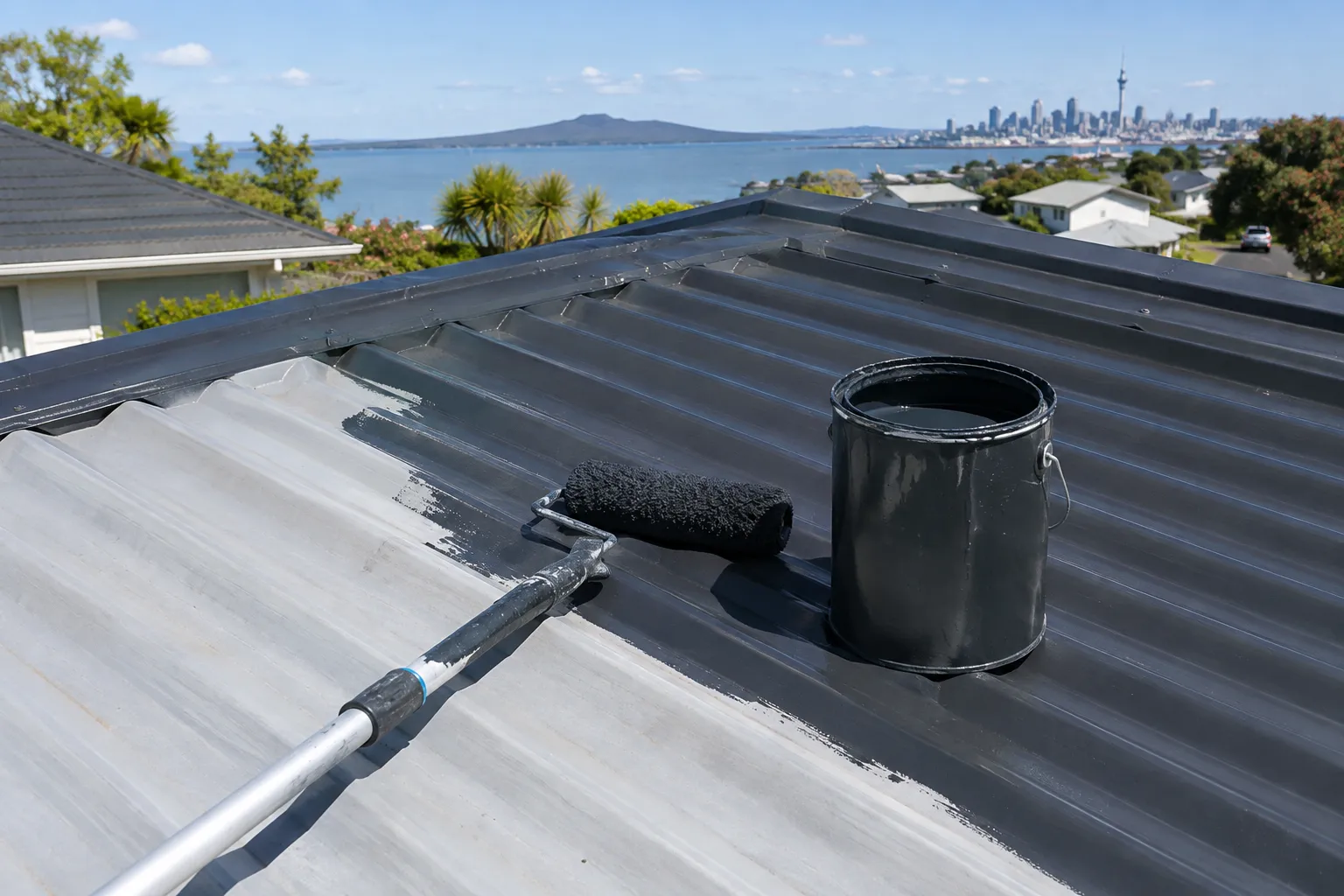
To paint a roof properly, you set up safe access, treat moss and lichen, clean the roof, make any repairs, prime or seal the surface to suit the roof type, then apply two topcoats in dry weather. In Auckland you also need to keep wash water and paint out of the stormwater drains, and check older roofs for asbestos before any water blasting. This guide is part of our roof painting in Auckland section. It walks through each step, explains what changes between iron and tile roofs, and helps you decide whether this is a job to do yourself or one to hand to a specialist.
Is it safe to paint your own roof?
Painting your own roof is safe only if you can manage the fall risk properly, and that is the hardest part of the job. WorkSafe New Zealand says more than half of falls are from under three metres, mostly from ladders and roofs, and it expects edge protection even on single-storey buildings. A wet or mossy roof is slippery, and tile roofs can break underfoot.
Before you decide to do it yourself, be honest about these:
- Height and pitch. A low-pitched single-storey roof is very different from a steep two-storey one.
- Edge protection. Scaffolding or a temporary edge barrier is the safe way to work near the edge. A ladder alone is not.
- Fragile areas. Skylights, clear sheeting and cracked tiles can give way.
- Weather. Never work on a wet, dewy or windy roof.
If any of these worry you, hire a specialist. The money saved on labour is not worth a fall.
What do you need before you start painting a roof?
You need safe access, the right cleaner and moss treatment, a primer or sealer that suits your roof, a roof topcoat for two coats, and the gear to apply it: a roller with an extension pole, a corrugated roller for iron, brushes for cutting in, or an airless sprayer. You also need a plan to stop wash water and paint reaching the stormwater drains, as Auckland Council requires.
A checklist:
| Item | Why |
|---|---|
| Scaffolding or edge protection | Manages the fall risk |
| Moss and lichen treatment | Kills growth before cleaning |
| Roof wash and paint cleaner | Removes dirt, chalk and residue |
| Primer or sealer for your roof type | Makes the topcoats grip |
| Roof paint for two topcoats | Protects and colours the roof |
| Rollers, brushes or airless sprayer | Applies the paint |
| Drain covers, bungs or sandbags | Keeps wash water out of the stormwater system |
| Non-slip footwear, gloves, eye protection | Personal safety |
How do you prepare a roof for painting?
Preparing a roof means killing moss and lichen, cleaning off dirt and loose paint, fixing damage, and letting the roof dry completely. On iron, scrub back rust and prime bare metal. On concrete tiles, water blast and replace cracked tiles. Preparation is where most of the time goes, and it decides how long the paint lasts.
The preparation steps, in order:
- Treat moss and lichen with a roof moss killer and give it time to work. Resene's moss and mould killer needs at least 48 hours on lichen.
- Clean the roof. Use a roof wash on metal and rinse well. On tiles, water blasting is the usual method.
- Check for asbestos first on older roofs. WorkSafe says high pressure water blasting (over 350 kPa, about 50 psi) must not be used on roofing that contains asbestos, and some older decramastic tiles may contain it. If you are not sure, get it tested before you clean.
- Protect the drains. Disconnect downpipes to unsealed ground, or block drains and remove the wash water afterwards, as Auckland Council's guidance describes.
- Repair damage: cracked tiles, failed ridges, rusted sheets, loose fixings.
- Let it dry. Tiles hold water after washing. Paint only once they are thoroughly dry.
Can I just paint over old paint on a roof?
You can paint over old roof paint if it is still firmly bonded and the surface has been cleaned. Chalky, flaking or peeling paint has to be washed and scraped back first, because new paint only holds as well as the layer under it. Bare metal and rusty spots get a metal primer, and porous tiles get a sealer, before the topcoats go on.
A simple test: press tape firmly onto the old paint and pull it off sharply. If paint comes away with it, that area needs scraping back.
What paint should you use on a roof?
Use a roof paint system made for your roof type: a metal primer and acrylic roof topcoat for galvanised iron, a topcoat approved for Colorsteel on Colorsteel, and a cement sealer plus roof paint on concrete tiles. Resene's system for weathered galvanised iron is Galvo One primer with two coats of Hi-Glo. Standard house paints are not made for roofs.
| Roof type | Primer or sealer | Topcoat |
|---|---|---|
| Weathered galvanised iron, Zincalume | Metal primer, two coats near the sea | Two coats of roof paint |
| Colorsteel | Spot prime white rust only | Two coats of a topcoat approved for Colorsteel |
| Concrete tile | Cement sealer | Two coats of roof paint |
| Previously painted, sound | Spot prime bare areas | Two coats of roof paint |
For more on each roof type, see iron roof painting and tile roof painting.
What is the best way to paint a roof?
The best way to paint a roof is in dry, settled weather, on a clean and completely dry surface, applying each coat at the thickness the maker specifies. Rollers suit corrugated iron, airless sprayers suit tiles and large areas, and brushes handle flashings and edges. Work in sections from the top down, and leave the drying time between coats that the product information gives.
Tips that make the finish last:
- Do not paint when rain is due before the coat dries, or when dew is still on the roof.
- Near the sea, hose off salt before each coat after an onshore breeze, as Resene advises.
- Avoid painting very hot metal in the middle of a summer day. Paint makers sell hot weather additives for a reason.
- Wash brushes and rollers to a sink or unsealed ground, never to a stormwater drain.
How much paint do you need for a roof?
To estimate the paint, multiply the roof area by the number of coats and divide by the spreading rate on the product information. Corrugated iron and textured tiles have more surface than their flat area, so add extra. A typical system is a primer or sealer coat plus two topcoats, so you need paint for three coats on bare or porous areas.
If you are hiring a specialist, they measure the roof and include the paint in the quote. The roof painting cost guide shows what a full job usually costs in Auckland.
When should you hire a specialist instead?
Hire a specialist when the roof is steep or two storeys, when there is no safe way to set up edge protection, when the roof is older and might contain asbestos, or when there is rust damage or cracked tiles to repair. A specialist also brings the scaffolding, the spray gear and the experience to finish in a few days.
Questions people ask
Do you need primer for roof paint?
Yes, on bare metal, rusty spots, new weathered galvanised iron and porous concrete tiles. The primer or sealer makes the topcoat grip and lasts longer. On a sound, previously painted roof, only the bare or rusty spots usually need priming before the topcoats.
How long does paint last on a roof?
A well-prepared repaint usually lasts around 10 to 15 years in Auckland. Coastal exposure, deep colours and rushed preparation shorten it, so roofs near the sea often need attention sooner. Resene gives the example of a deep-coloured metallic roof repainted about every 8 to 9 years.
Can you paint a roof in winter in Auckland?
You can, on dry days, but winter makes it harder. Dew lingers in the morning, roofs take longer to dry after washing, and short days leave less time for each coat to dry before evening. Most specialists prefer the drier months, from late spring to early autumn, but will paint in winter when the forecast allows.
Can you spray paint a roof yourself?
You can, but airless spraying takes practice to get an even coat, and overspray can travel onto cars, windows and neighbours' property in a breeze. Rolling is slower but easier to control. If you spray, mask everything below the roof and choose a calm day.
How long does it take to paint a roof?
A specialist usually paints a typical house roof in a few days of work once the preparation is done, though weather often stretches that over a week or two. Doing it yourself usually takes much longer, especially the cleaning and drying. Moss treatments may also need time to work before cleaning starts.
Sources used
- WorkSafe New Zealand, working on roofs
- WorkSafe New Zealand, check for asbestos before high pressure spraying on roofs
- Auckland Council, pressure washing and water blasting guidance
- Auckland Council, preventing paint pollution of waterways
- Resene, paint system for weathered unpainted galvanised iron and Zincalume
- Resene, roof painting questions answered by its technical team
Last changed